
“Anyone Who Violated This Principle Had To Dig A Grave For Himself.” Appeal Hearings Begin
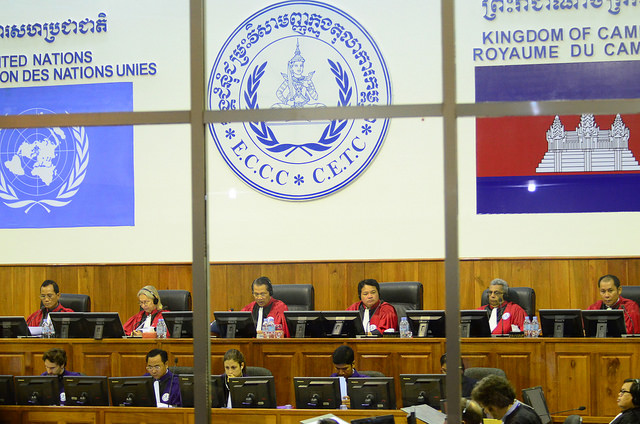
The Bench of the Supreme Court Chamber as seen from the public gallery on July 2nd, 2015 (ECCC Flickr)
Today, July 2, 2015, the Supreme Court chamber held the first appeal hearings on case 002/01. These first hearings are only focused on three witness called by the defense: SCW-3, 4 and 5. The Chamber’s decision on the appeals is expected in the first quarter of 2016. (Some background on these appeals, prepared by the court, can be found here.)
Case 002/01 only focuses on:
- Forced Evacuations
- alleged crimes against humanity related to the forced movement of the population from Phnom Penh in April 1975 and later from other regions (phases one and two)
- Executions of Lon Nol Soldiers
- alleged execution of 250 Khmer Republic soldiers and officials at Toul Po Chrey execution site in Pursat immediately after the Khmer Rouge takeover in 1975
Case 002/01 began on November 21, 2011. After 222 trial days over a two year period, both defendants, Nuon Chea and Khieu Samphan, were found guilty of both crimes above and sentenced to life imprisonment. The decision was rendered on August 7, 2014 (You can find a summary of the ruling here.) The accused are still presumed innocent until a final judgment is given by the Supreme Court chamber.
Nuon Chea filed a 270-page-long appeal resting on 223 different grounds. Khieu Samphan filed a 210-page-long document in french for now with 150 grounds of appeal. The prosecution also appealed the Trial Chamber judgment on one single issue of law.

Nuon Chea in Court on July 2nd 2015 (ECCC Flickr)
As the first hearings scheduled on the appeal of case 002/01 began today on July 2, 2015, both Nuon Chea and Khieu Samphan were present in the court room for the first session. (Nuon Chea had not appeared at the Chamber since May 18, at least, due to back pain. He would retire to his holding cell after the first session).

The President of the Chamber Judge KONG Srim
The President of the Chamber Judge KONG Srim summarized the trial chamber’s decision of August 7, 2014. He then handed the floor to Judge YA Narin and Judge Florence Ndepele to summarize, as rapporteurs, the appeals that have been filed by the parties.
The main thrust of the appeals as related to these three defense witness, as summarized by both judges, is that the defense teams challenge the decision of the Trial Chamber that authority in the DK rested in the Party Center and that it was unified, hierarchal and pyramidal. That is, the defense teams allege that there were warring factions, which would go against the idea of effective control from the party center. The defense teams also allege that Trial Chamber downplayed the authority of the zone centers, which defense teams allege, could actually make decisions on their own.
Furthermore, the defense challenges the finding of the Trial chamber that there was a consistent and systematic policy to exterminate Lon Nol Soldiers.
The Trial Chamber held, through the testimony of three witnesses, that at least 250 Lon Nol Soldiers were transported to Tuol Po Chrey and executed. Nuon Chea’s defense said in its appeal, as summarized by the rapporteur judges, that the witness were not present and gave contradictory evidence. The prosecution on the other hand says that the evidence for the three witness is consistent and that the Trial Chamber was reasonable in making its finding.
The first witness, SCW-4 was then ushered into the Court Room.

Witness Sao Van alias Sao Pau (ECCC Flickr)
The witness’ name was Sao Van alias Sao Pauk. He was born on the 15th of April of 1941 in Srekhav village, Cheang Torng commune, Tramkok district, Takeo Province. His father’s name is Sao Mg, his mother’s Soh Keng and they both passed away. His wife’s name is Nhim Eun and they have nine children, five sons and four daughters.
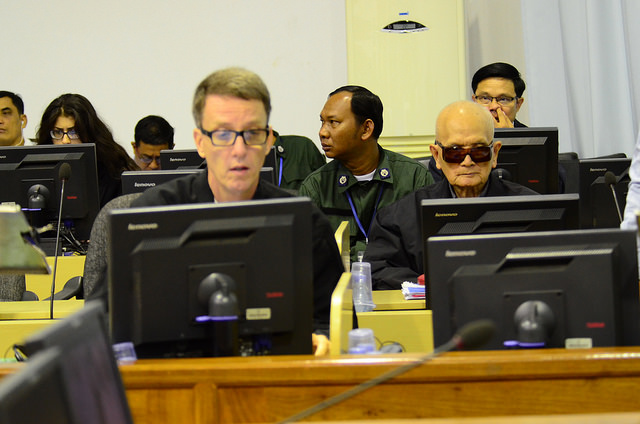
Victor Koppe, international co-counsel for the defense of Nuon Chea, with Nuon Chea in the background. Jule 2nd 2015. (ECCC Flickr)
The floor was first given to the defense teams. Victor Koppe, international co-counsel for the defense of Nuon Chea, started the examination.
Mr. Koppe confirmed that Mr. Van had given an interview to the Office of the Co-Investigating Judges (OCIJ) on February 13. Mr. Koppe also confirmed that that Mr. Van spoke to DC-Cam on April 2011. When Mr. Koppe attempted to read from the DC-Cam interview, Mr. Koumjian, the International Co-Prosecutor, reminded the Chamber that the DC-CAM statement had been excluded from today’s hearing by a ruling that had come out the night before. Mr. Koppe agreed but said he only wanted confirmation.
Siblings
Mr. Van has seven siblings: two brothers and five sisters. His elder brother, Sao Chrun was a deputy commune chief during the Lon Nol Regime (1970-75) in quarter six in Phnom Penh. His younger brother was just a rice farmer during those years.
After 17 April 1975, his older brother had to leave Phnom Penh. “He told my parents he was heading North to Kampong Thom,” Mr. Van explained “Three months later he arrived at our house. Due to his previous position he was called to attend an education session at office 24 in that area.” Mr. Koppe confirmed that he was arrested and detained at Office 24.
His younger brother had no issues “as he was simply a peasant,” Mr. Van said.
Positions within DK and before
On the 30th of September of 1971 “Angka assigned me to the position of Chief of the Cheang Torng commune,” Mr. Van told the Chamber, “and I was in that position until 1975 when the war was over.” He was later sent to Sector 25.
As the chief of the Cheang Torng front his duty was to collect “all the people who were loyal to the party to fight against the Lon Nol forces. Angka told us to join together to fight the imperialist America who had Lon Nol depose the Late King Sihanouk,” Mr. Van said
Mr. Van also confirmed to Mr. Koppe that he didn’t hold any other functions apart from being a member of the committee at Popel. He said he was part of the re-education committee there.
Meeting with Ta Som, Ta Muth, and Ta Penh
Mr. Van said he remembers that Ta Som, Ta Muth, and Ta Penh were in charge of Sector 13 and that he attended a yearly meeting.
There they “circulated the instructions from the upper echelons” Mr. Van said. “Everyone had to implement those instructions regardless of their understating, he continued, “first it had to be implemented and then you could ask. You had to respect the command structure. You had to respect the upper echelon.”
Meeting with Ta Mok presiding
Mr. Van said he attended a meeting which was led by Ta Mok (nicknamed “The Butcher”, leader of the South West Zone).
Mr. Van said he was present for an hour. He said that the content of the meeting was to remind the soldiers and the peasants to “to hold our solidarities and produce more rice yield.”
Mr. Van then said that Ta Mok told them (in a quote that would be picked up by the prosecution and the bench) that:
“In the issue of life and death, we did not have the authority to decide the life and death of the people. Anyone who violated this principle had to dig a grave for himself.”
Ta Mok, according to Mr. Van did not say anything about the former soldiers of the Lon Nol army at that meeting.
Meetings at Krael Mountain and at Takeo provincial town
Mr. Van recalled that there were two meetings were Ta Mok, Ta Som and Ta Bith were present, where, according to Mr. Van, it was announced that former soldiers up to the rank of colonel would not be harmed.
One meeting was held at Krael Mountain and another at Takeo Provincial town, (as Mr. Koppe referred to it).
Mr. Van recalls being “jubilant when hearing that foot soldiers up until the rank of colonel would not be harmed.”
Mr. Koppe attempts to ask whether this was because his brother had been a civil servant of the Lon Nol regime, but Koumjian objects. Mr. Koppe rephrases to ask if there were any personal reasons why he was jubilant and Mr. Van admits that it was partly due to the fact that his brother had been part of the Lon Nol regime.
The floor is then given to Arthur Vercken, lawyer for Khieu Samphan.

Mr. Arthur Vercken, lawyer for Khieu Samphan (right) consulting with his client on July 2nd 2015 (ECCC Flickr)
American bombings
Mr. Vercken started by confirming that Mr. Van had lived through the American bombings. Mr. Van said that the houses of people in the Cheang Torng commune caught fire and cattle were destroyed. He also said that some lives were lost.
“Did the bombings influence you?” Mr. Vercken asked.
“Yes. Mr. Van responded, “your question is on the spot. They moved people.”
“Moved them towards the revolution?” Mr. Vercken pressed.
“At that time I did not know what the revolution was. But after Sihanouk was deposed, the people joined that movement to liberate the country,” Mr. Van responded.
Dirty Traitors Broadcast
Mr. Vercken spoke about a speech given by his client, Khieu Samphan before 1975. He referred to it as the speech of the “dirty traitors,” where allegedly Khieu Samphan said that only the seven foremost leaders of the Lon Nol Regime (Lon Nol, Sirik Matak, Son Ngoc Thanh, In Tam, Cheng Heng, Long Boret and Sosthene Fernandez) would be harmed.
Mr. Vercken then asked about the two meetings were Mr. Van had said that he had been told that every soldier of the former Lon Nol regime up to the rank of colonel would be spared. Mr. Van repeated that he had been “jubilant” when he heard the news. He said that “we were happy because that would strengthen the solidarity between the base people and those arrived from Phnom Penh.”
Mr. Vercken then attempted to ask if the promises that Khieu Samphan had made in the speech were met. Mr. Koumjian objected by saying that Vercken was suggesting the answer. Mr. Vercken rephrased to ask Mr. Van what was the source of his joy.
“I was happy to hear his message after the war ended,” responded Mr. Van.
“Why was it necessary to remind people of this [that allegedly soldiers up to the rank of colonel should not be harmed]?” continued Mr. Vercken.
“My understanding,” Mr. Van said “is that the message was broadcast to unify the entire Cambodian population…The principle at the end of the war was to form solidarity to build the country.”
Food
Mr. Van insisted that food was more than enough. Mr. Van said that in 1976 people were given a food ration of 20 grams of rice with corn per meal. He then said that in 1977 and 1978, “there was sufficient food for everyone. In addition, the surplus was given to Angka in the form of un-husked rice.”
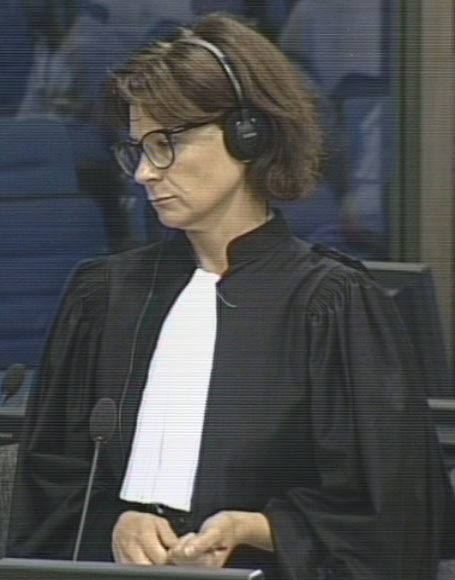
Ms. Marie Guiraud, International Civil Party Lead Co-Lawyer
Ms. Marie Guiraud, International Civil Party Lead Co-Lawyer, objects as she believes these questions are outside the scope of the appeal.
The President reminds Vercken that the main focus of the appeals are the decision making authority of the first and second evacuations and the murder of Lon Nol Soldiers at Toul Po Chrey.
Mr. Vercken agrees but says he’s asking about the cooperatives. He then asks if Mr. Van ever received any instructions to starve people.
“We did not receive instructions to starve the people, Mr. Van replies. “On the contrary,” he continued, “cadres were charged with providing with the livelihood of people.
“Did you have any decision making authority?” Mr. Vercken continued.
“I did not have any decision making authority,” Mr. Van replied, “so any outcome was because of the decisions of the upper level when they ruled on the requests made to them.”
The Court breaks for lunch and the floor is given first to the civil party co-lawyers.
Civil Parties
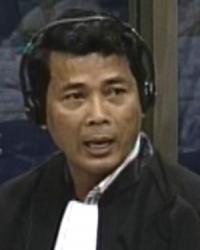
Mr. VEN Pov, Civil Party Co-Lawyer
Mr. VEN Pov, Civil Party Co-Lawyer, takes the floor and attempts to reads excerpts from civil parties as to the extent of the policy of exterminating former Lon Nol Soldiers regardless of rank.
Mr. Pov reads from a victim impact statement given before the Trial Chamber on the 27th of May 2013: “The Khmer Rouge asked me to make my biography but because I saw many soldiers and civil servants were arrested, I lied at that time… I witnessed the incident by my own eyes… people declared that they were first or second lieutenants or colonels and they were taken away by motorbike.”
After this first excerpt, Mr. Koppe objects as the excerpt is related to events outside of district 105 and the witness cannot testify to their veracity.
The President asks if these types of question are leading questions and Ms. Guiraud explains why they are not.
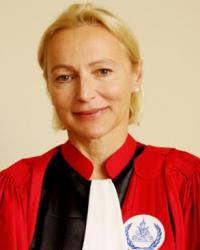
Judge Agnieszka Klonowiecka-Milart
Judge Agnieszka Klonowiecka-Milart intercedes to say that the Chamber allows the use of Civil Party testimony but she asks the civil parties to name the place to where the civil party is referring in the excerpt.
Mr. Pov backs down and doesn’t continue.
Mr. Pov then attempts to ask whether Mr. Van had the right to refuse when he was ordered to kill people.
Mr. KONG Sam Onn, Co-Lawyer for Khieu Samphan, objects. The objection is overruled but Mr. Pov backs down again.
Prosecution
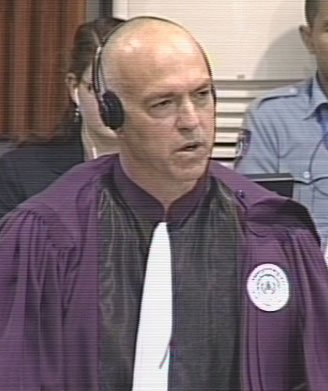
Mr. Nicholas Koumjian, International Co-Prosecutor
Mr. Nicholas Koumjian, International Co-Prosecutor, then took the floor.
After having a little bit of trouble getting Mr. Van to admit that he had been under the authority of Ta Mok during the CPK period, Mr. Koumjian appealed to the setting and the time.
“Sir, I know you are looking straight ahead,” Mr. Koumjian started, “as you should be.” “Behind you there’s an audience,” he continued “that includes many young Cambodian people. Can you tell them, since you were there, an official, during the Khmer Rouge regime, did the Khmer Rouge kill people during the regime?”
Victor Koppe rose in objection to exhort the prosecutor to “leave the theatrics away.” Koppe said the testimony was before the Supreme Court Chamber. Mr. Kong Sam Onn, lawyer for Khieu Samphan also objected on the grounds that the question was too general.
The objection was overruled and Koumjian asked again: “Did the Khmer Rouge kill people?”
Mr. Van responded: “I do not know if the Khmer Rouge killed people.”
Koumjian continued to press the point:
“Have you ever been to Kraing Ta Chan? (a prison and detention center part of case 002/02 where it is alleged that more than 10,000 people were executed)” asked Mr. Koumjian.
“Yes. I’ve been,” Mr. Van responded “I saw graves. I saw skeletons and bones. and I recognize that something happened. However, during the period from 1975-79 I knew nothing.”
“Should the judges understand then,” Mr. Koumjian replied, “that you know nothing about what happened in the DK except what happened in your commune?”
“Yes,” Mr. Van replied.
Khmer Rouge or DK?
Mr. Koumjian, Mr. Koppe and Mr. Vercken had a brief argument about how to refer to period in question.
Mr. Koumjian wanted to refer to the period as the Khmer Rouge period as it is “the one that we all know” and it “is consistent.” He then added that Democratic Kampuchea was a name “that certainly doesn’t fit.”
Mr. Vercken said that the Khmer Rouge was a title that had “no historical basis in this case.”
Mr. Koppe added that using Khmer Rouge was an “ahistorical proposition.”
“In ’71 it was called the Front,” Mr. Koppe explained, “The majority of the people in the Front were not members of the CPK. Then there was a period between ‘75 and the DK government installment, and then there was when the CPK possibly came into charge completely.”
The President asked the prosecutor to be precise and reminded the Chamber that the temporal jurisdiction here in these hearings was only from 1975 to 1977.

Witness Mr. Van (ECCC Flickr)
Religion
Mr. Van, a Buddhist, told the prosecutor that the DK did “not prohibit Buddhism at all.” He insisted that he practiced Buddhism throughout the whole period from 1975-79.
“From 1975 to 1979, I practiced my Buddhism in my capacity to adhere to the five principles,” Mr. Van said and then only mentioned four principles (which don’t seem to correspond to the five accepted precepts of Buddhism): “that is, not to oppress people, not to involve in drinking, not to kill animals, and not to engage in gambling.”
Mr. Koumjian attempted to ask about what had happened to the Pagodas in his region, but Mr. Vercken objected as it was presumably outside of the scope of the hearing. Mr. Koumjian noted that he hoped that the Judges would “consider the timing of the objections,” and moved on.
Petit Bourgeois risk
Mr. Van explained to the Court that he was considered a “petit bourgeois” because he had completed the 7th grade. He conceded that being considered a “petit bourgeois” was a risk because people who could read and write would not blindly follow orders.
“Illiterate people,” Mr. Van explained, “. . .those who knew very little about reading and writing . . . would be the right people [because they] would blindly follow the instructions. For example if they were [told] to go left, they would go left; if they were [told] to go right, they would go right. And as for us the petit bourgeoisie it would be rather difficult for them to lead us since we were educated.”
Brother not detained?
Mr. Koumjian asked Mr. Van about his elder brother who had been a civil servant of the Lon Nol regime. When he returned to Mr. Van’s home in Takeo, he was arrested and detained at the security office number 204 (to Koppe Mr. Van, according to the translation, had said office 24 instead of 204).
Mr. Van insisted that office 204 was not a prison. “It was a place for re-education, they went to compact soil,” he insisted.
Later Mr. Van said that his brother had been released in 1979. Mr. Koumjian asked thus, if his brother had been held form 1975 to 1979 in office 204. Mr. Van continued to insist that he had never said that his brother had been detained. “He was living with his wife,” Mr. Van said, “he was with hundreds of people. In 1979 the situation changed and he arrived home.”
Documents from Popel: policy of exterminating soldiers
Mr. Koumjian asked the chamber for permission to show some document form Popel commune to confront the witness. The documents said exactly the opposite of what Mr. Van had testified to as to the policy of exterminating Lon Nol soldiers. The document says that enemy officers were to be purged.
Mr. Koppe and Mr. Vercken objected on the grounds that Mr. Van was not the author nor the recipient, and it was not his commune. Additionally Mr. Koppe added he was long gone from Popel in 1977 so he would not have any information. Mr. Vercken added that it is outside of the scope.
The Bench decides to allow the prosecutor to put the documents to the test and that the witness can say that he has no knowledge if indeed he has no knowledge.
When Mr. Koumjian asks Mr. Van if there was a policy to track and purge soldiers, Judge Milart interrupts and reminds him that allegedly the prosecution had objected to this type of questioning in the morning from the defense. Judge Milart asks the prosecutor to inquire as to whether there was a change in policy.
Mr. Kuomjian resorts to asking whether Mr. Van can explain this document given his prior testimony and Mr. Van answers that he was not there and doesn’t have any knowledge.
“Digging your own grave”
Mr. Koumjian returns to the phrase Mr. Van had said earlier about digging your own grave if you disobeyed Ta Mok’s instructions. The context in the morning had been that if anyone decided to take or spare a life then he would be digging his own grave, as Koppe and Milart reminded the chamber.
In testimony with Mr. Koumjian, Mr. Van said something different.
“Mr. Witness,” Mr. Koumjian asked, “you told us this morning, if my recollection is correct, that Ta Mok told you that anyone who didn’t follow his instructions would suffer — I forget the exact words. But they would be — that they had to or they would suffer the consequences; is that correct? That they would dig their own grave; is that correct?”
“Yes,” Mr. Van answered, “Ta Mok said if one did not follow the instructions, that individual had to dig his own grave. This was the statement of Ta Mok.”
Mr. Koumjian attempted to ask if Mr. Van ever saw or witnessed anyone disobey an order from Ta Mok. Judge Milart insisted on clarifying that Koumjian meant any and all orders. Mr. Koumjian said yes, that he meant any and all orders. Koppe and Kong Sam Onn object, there are technical difficulties and the prosecutor decides to move on “in the interest of time.”
What does “smashed” mean?
Mr. Koumjian reads a report where it is said that “106 military families were smashed by Angka, for a total of 393 persons.” Mr. Koppe and Mr. Vercken object but their objections are overruled.
Mr. Koumjian asks Mr. Van if he knows what “smash” means. Mr. Van responds that he had no involvement “in the number of people that you quoted.”
“As for the definition,” Mr. Van continues, “ for the the word smashed… if it refers to a human being, it means killed or died.”
—
Coming to the end of the hearing, Judge Milart and Judge Monichariva have some questions in which the witness appears confused as to when the meetings with Ta Mok he had mentioned earlier (at Takeo and at Krael Mountain) occurred. First, Mr. Van appears to say that the meeting at Takeo was five days after the 17 of April of 1975, then he says that the meeting was in late 1976. The confusion is left unresolved.
The hearing comes to an end and the Court will hear witness SCW-3, tomorrow Friday July 3rd.
—
[…] On July 3rd the appeal hearings for case 002/01 continued into their second day out of three. The Supreme Court chamber heard the testimony of witness SCW-3, Mr. Sâm Sithy. (For background on case 002/01 and the appeal hearings, please refer back to the introduction of yesterday’s post). […]
[…] treatment of Lon Nol soldiers and authority structures in Kieng Svay Commune. He had testified on July 07 2015 in front of the Supreme Court Chamber. He confirmed his former statement that former Lon Nol […]